Ask any Indian who’s thinking about learning Japanese, and one worry comes up before every other question:
“Isn’t Japanese really hard?”
I’ve heard this question thousands of times over the last 25 years — from teenagers, engineering graduates, homemakers, retired professionals, and CEOs.
And every time, I answer the same way:
“It’s not hard. It’s just unfamiliar.”
There’s a big difference between those two words. And once you understand that difference, Japanese stops feeling scary — and starts feeling like one of the most rewarding skills you can build in your lifetime.
Let me explain why.
Fascinated by Japan? Learn the language at SNRC — JLPT N5–N1 & NAT 5Q–1Q.
View CoursesWhere the Fear of Japanese Comes From
Most Indians who feel intimidated by Japanese have never actually studied it. Their fear is based on three assumptions:
- Japanese has “thousands of complicated characters”
- The grammar is nothing like English
- It takes years to speak even basic sentences
All three assumptions are partly true — but each one has an important nuance that beginners rarely hear.
Let’s take them one by one.
The Script Situation — Actually Simpler Than You Think
Japanese uses three scripts: Hiragana, Katakana, and Kanji.
Sounds overwhelming. It isn’t.
- Hiragana: 46 characters. Most learners master it in 2–3 weeks.
- Katakana: Another 46 characters, similar logic. 2–3 weeks.
- Kanji: Yes, thousands exist. But you don’t need thousands. For JLPT N5, you need about 100 kanji. For N4, around 300. Even N2 requires only about 1,000.
For JLPT N5, you need about 100 kanji — the exact list is published by the https://www.jlpt.jp/e/about/levelsummary.html.
Compare that to Hindi, Tamil, Malayalam, or Kannada — all of which have complex scripts that Indians pick up naturally as children.
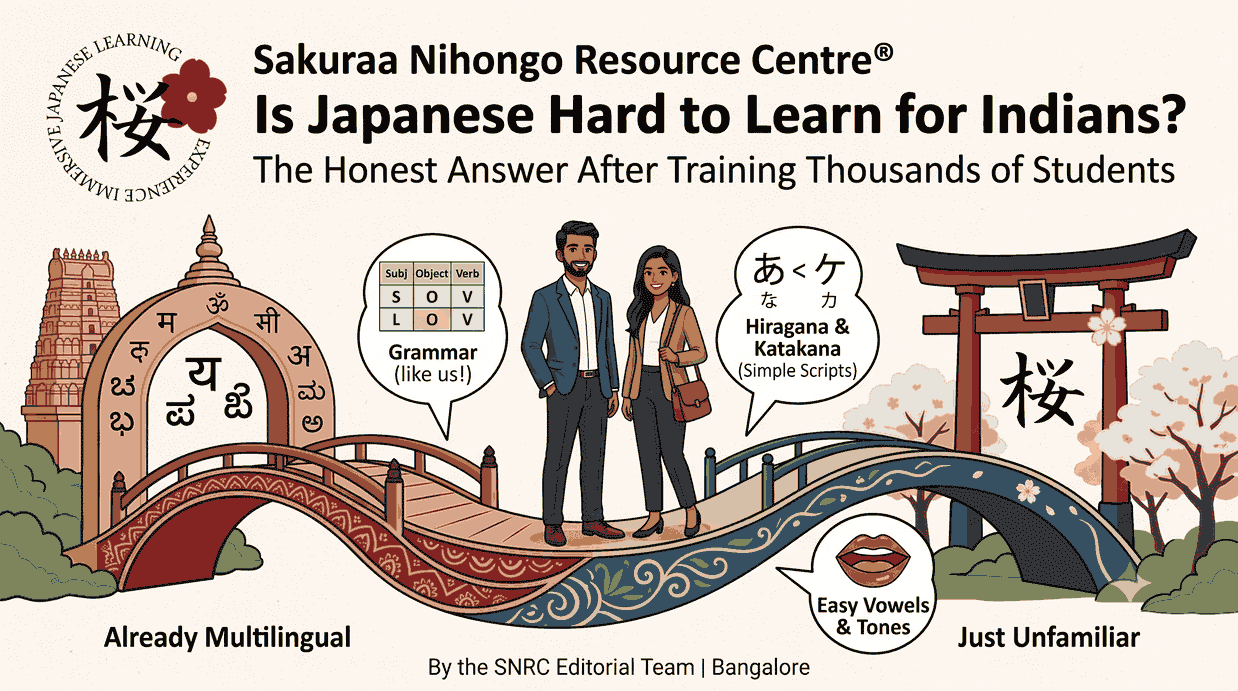
The truth is, Indians are already wired to learn multiple scripts. Japanese fits right into that comfort zone.
The Grammar Actually Favours Indian Learners
Here’s something that surprises most students in their first month at SNRC:
Japanese grammar is closer to Indian languages than to English.
- The verb comes at the end (just like Hindi, Kannada, Tamil, Bengali).
- There are particles that behave like Indian language postpositions.
- Sentence structure is Subject–Object–Verb — the same pattern most Indian languages follow.
Ask any Hindi speaker to translate “I eat rice.” Naturally it becomes “मैं चावल खाता हूँ” — Subject, Object, Verb.
That’s exactly how Japanese works: Watashi wa gohan wo tabemasu.
For a native English speaker, this feels alien. For an Indian, it feels familiar.
This is one of the quiet reasons Indians often progress faster in Japanese than European learners do.
Pronunciation Is Genuinely Easy for Indians
Japanese has only five vowel sounds — a, i, u, e, o. Almost identical to the vowels in most Indian languages.
There are no complex tones like Mandarin. No throaty sounds like German. No silent letters like French.
Most Indian students sound naturally clear in Japanese within a few weeks. Japanese trainers regularly comment on how comfortable Indian mouths are with the language’s rhythm.
If you can speak an Indian language, you can pronounce Japanese well. It’s really that straightforward.
So Why Do Some People Still Find Japanese Hard to Learn?
Let me be honest here. Some students do struggle with Japanese — but rarely because the language is “hard.”
The real reasons usually are:
- Learning on their own without a structured curriculum
- Skipping Hiragana/Katakana practice in the early weeks
- Not speaking enough in class
- Trying to shortcut Kanji through memorisation tricks
- Studying inconsistently — an hour today, nothing for two weeks
Japanese rewards regularity, not intensity. Fifteen minutes daily beats three hours on Sunday. Every time.
Students who follow a structured programme with regular practice reach usable Japanese within 4–6 months. That’s not a marketing claim — that’s what we consistently see with our own N5 and N4 batches.
What Kind of Indian Learner Does Best?
Over the years, we’ve noticed a pattern.
The students who thrive in Japanese aren’t the “brightest” or the “most talented.” They’re the ones who:
- Show up consistently
- Ask questions without hesitation
- Aren’t afraid of making mistakes
- Enjoy small daily progress
That’s it. No magic. No IQ requirement. No prior language experience needed.
We’ve had housewives outperform engineers. Commerce students outperform IT professionals. Retired teachers outperform young graduates.
Japanese is remarkably democratic that way.
The Real Question You Should Be Asking
Instead of asking “Is Japanese hard?”, ask yourself:
“Am I willing to spend 20–30 minutes a day for the next 6 months?”
If your answer is yes, you can absolutely learn Japanese. And more importantly, you can build a career, a network, and a lifelong skill from it.
If the answer is no — no language will feel easy, not even English.
A Final Word From Our Side
At SNRC, we’ve trained thousands of learners since 2000. Almost all of them started with the same fear you might be feeling right now. Almost all of them look back and laugh at that fear a few months later.
Japanese isn’t hard. It’s just new. And new becomes normal faster than you think.
If you’re ready to take the first step, our N5 batches start every month. All you need is curiosity and consistency. We’ll take care of the rest.
Frequently Asked Questions – FAQS
Not necessarily. Japanese grammar aligns closely with Indian language structure, making it more intuitive for Indian learners than for European learners.
Only about 100 Kanji are required for JLPT N5.
With a structured programme and consistent study, most learners reach usable Japanese in 4–6 months.
Yes — most SNRC batches are designed to fit around working professionals’ schedules.
Ready to take the first step?
Whether you’re a student, a working professional, or exploring career pathways in Japan business — our N5 batches begin every month.
🎓 Explore JLPT Courses | 📞 Talk to Us | 💬 WhatsApp