
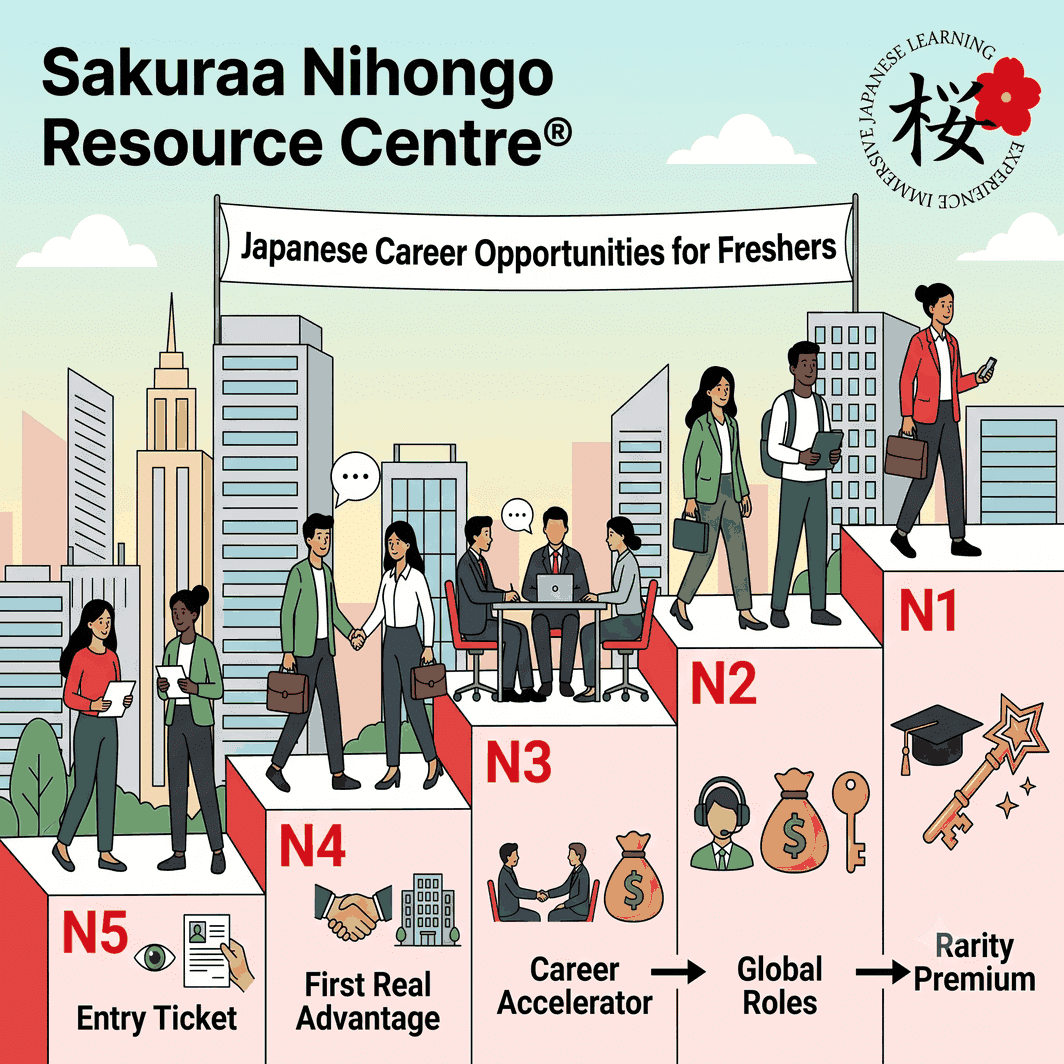
Every fresher who walks into our institute has one question hidden behind all their other questions.
“If I learn Japanese, what will actually happen to my career?”
It’s a fair thing to want to know. Learning a new language is a serious time commitment. Nobody wants to spend a year of evenings on something that leads nowhere.
So let’s answer this properly — not with hype, not with vague promises, but with a realistic roadmap of what Japanese can do for a fresher’s career, level by level.
If you’re a college student, a recent graduate, or someone still figuring out your first serious job, this is written for you.
Fascinated by Japan? Learn the language at SNRC — JLPT N5–N1 & NAT 5Q–1Q.
View CoursesLet’s First Clear One Misconception
A lot of freshers assume that Japanese is useful only if you plan to move to Japan. That’s not true.
The majority of Japanese-language job opportunities for freshers today are within India.
Japanese MNCs, global capability centres, IT firms with Japan projects, automotive companies, banks, pharma majors, engineering consultancies, e-commerce firms — all of them hire freshers with even basic Japanese proficiency.
Your Japanese skills open doors before you ever think about Japan. That’s important to understand from the start.
The Roadmap: What Each JLPT Level Actually Means for a Fresher
Let me break this down honestly — no exaggeration, no downplaying.
N5 — Your Entry Ticket
N5 is your basic proficiency level. You can introduce yourself, hold small conversations, understand simple written text, and communicate at a foundational level.
At N5 alone, freshers don’t usually get “Japanese-specific” jobs. But something more valuable happens:
Your resume becomes noticeable.
In interviews, when a fresher mentions they’re currently studying Japanese at N5, hiring managers pay attention. It signals:
- You’re proactive
- You’ve chosen a rare skill
- You have long-term career thinking
Many freshers land their first job in Japan-linked companies at this stage — not because of N5 skills alone, but because employers see potential.
Typical fresher salary at this stage: same as regular market, but with a foot inside a Japan-linked ecosystem, which matters for the next few steps.
N4 — Your First Real Advantage
N4 is where things start to shift.
At this level, you can handle short conversations, understand common workplace phrases, read basic notices and emails, and follow slower Japanese conversations.
Companies begin to consider you for roles like:
- Junior coordinator in Japan-linked teams
- Support roles for interpreters and senior bilinguals
- Documentation assistance
- Trainee programs specifically designed for Japan business units
Fresher salaries at this level usually see a 10–20% premium over peers in equivalent roles without language skills.
N3 — The Career Accelerator
N3 is where your Japanese becomes professionally useful.
You can hold structured conversations, handle daily business communication, understand meeting content at a reasonable level, and read regular workplace documentation.
Roles that open up at N3 for freshers include:
- Business coordinators
- Junior interpreters and translators (with supervision)
- Customer support for Japanese clients
- Analyst roles in Japan-focused BFSI teams
- Documentation and localisation specialists
- Junior liaison roles in manufacturing companies
Freshers with N3 typically see 25–50% salary premiums over non-language peers. And your career growth accelerates because you become useful in ways that peers cannot replicate.
N2 — The Level That Changes Everything
N2 is the professional benchmark in the Japanese-language job market.
At N2, you can participate confidently in workplace discussions, read business documents, handle client-facing communication, and function comfortably in a Japanese-speaking environment.
For freshers, N2 unlocks:
- Bilingual analyst and coordinator roles at MNCs
- Bridge roles between Indian teams and Japanese HQ
- Full-time interpreter and translator positions
- Localisation lead roles
- Client-facing account management for Japan business
- Structured opportunities to be sent to Japan for training or short-term assignments
Salary premiums at N2 for freshers can easily reach 50–80% above non-language peers, depending on the sector.
More importantly, your career trajectory changes. You move from being “a fresher who knows some Japanese” to being “a bilingual professional employers actively look for.”
N1 — The Rarity Premium
N1 is the highest JLPT level. It is difficult, requires disciplined preparation, and only a small percentage of test-takers clear it globally each year.
For freshers who reach N1, doors open at the highest level:
- Senior interpreter and translator roles
- Regulatory and compliance liaison positions
- Leadership tracks in Japan business units
- Client-facing positions with Japanese principals
- Consulting roles focused on Japan corridor business
- Fast-track career paths for Japan deputations
At N1, you’re no longer competing in the general job market. You’re in a niche where demand exceeds supply, and salaries reflect that.
The Timeline You Should Realistically Expect
Here’s a rough but honest timeline for freshers who study consistently:
- N5: 4–6 months
- N4: 6–9 months after N5
- N3: 9–12 months after N4
- N2: 12–18 months after N3
- N1: 12–24 months after N2
So a fresher who starts today could realistically reach N3 in 18–24 months and N2 in about 3 years. That’s within an early career window, which is exactly when the returns are highest.
The Mistake Most Freshers Make
The most common mistake we see is treating Japanese as a “backup” plan while chasing other things half-heartedly.
Japanese doesn’t reward casual learners. It rewards consistent learners.
Freshers who commit to a proper structured programme and stay regular for 12–18 months always outperform freshers who “try to learn from apps in their free time.” Every single time.
Language learning is like compound interest. Small daily inputs create disproportionate results over time. But you have to actually stay in the game.
A Word About CV Visibility
One thing freshers rarely think about — even after you learn Japanese, you still need employers to find you.
Japan-focused hiring in India often happens through trusted recruitment channels and specialised databases rather than open portals. Being visible in the right ecosystem matters as much as being qualified.
At SNRC, we help our own students with this — from CV positioning to placement introductions — because we know how the Japan-linked hiring market actually works in India.
Where to Start
If you’re a fresher reading this, start with N5. That’s it. Don’t overthink the roadmap. Don’t research 47 different institutes. Don’t wait for “the right time.”
Learning Japanese is one of those decisions that gets easier once you take the first step and gets harder the longer you delay it.
Our N5 batches begin every month. If you’d like to talk through your background and figure out the right fit, we’re happy to help.
Your future self will thank you.
Frequently Asked Questions – FAQS
N5 alone rarely gets Japanese-specific jobs, but it opens doors to Japan-linked companies and signals long-term potential to employers.
N3 is where Japanese starts becoming professionally useful. N2 is the level that meaningfully changes career trajectory.
With consistent study, a fresher can typically reach N2 in about 3 years, depending on time commitment.
IT, automotive, manufacturing, BFSI, pharma, consulting, and Japanese MNCs across Bangalore, Pune, Chennai, Gurgaon, and Hyderabad.
📞 Sakuraa Nihongo Resource Centre® — +91 89043 90300 / +91 80 2346 4677 ✉️ info@snrc.co.in 📍 Bangalore, India

