
Why Japanese Business Etiquette Matters for Indian Professionals
Working with a Japanese company is not like working with any other multinational. It is a completely different professional culture — subtle, quiet, deeply structured, and shaped by hundreds of years of social discipline. For Indian professionals, especially those in IT, automotive, engineering, pharma, or corporate roles that involve Japan, understanding Japanese business etiquette is not a nice‑to‑have. It is a real professional advantage.
At Sakuraa Nihongo Resource Centre® (SNRC), we have delivered 180+ Japanese Business Etiquette workshops for Indian corporate teams since 2000 — with companies including Toshiba, Toyota, TCS, Wipro, Bosch, HCL, and Rakuten. Over the years, we have seen the same cultural gaps show up again and again. This article distils the 10 most important etiquette rules every India‑Japan professional should genuinely master.
If you work with Japanese clients, colleagues, or employers, this guide will help you show cultural intelligence — the kind Japan quietly notices and remembers.
📋 Table of Contents
- 👉 10 Essential Etiquette Rules
- • 1. Meishi Koukan (Business Cards)
- • 2. O-jigi (The Bow)
- • 3. Jikangenshi (Punctuality)
- • 4. Indirect Communication
- • 5. Hierarchy and Seniority
- • 6. Ma (Power of Silence)
- • 7. Wa (Group Harmony First)
- • 8. Nomikai (After-Work Relations)
- • 9. Omiyage (Art of Gifting)
- • 10. Seiketsukan (Presentation)
- 👉 Frequently Asked Questions
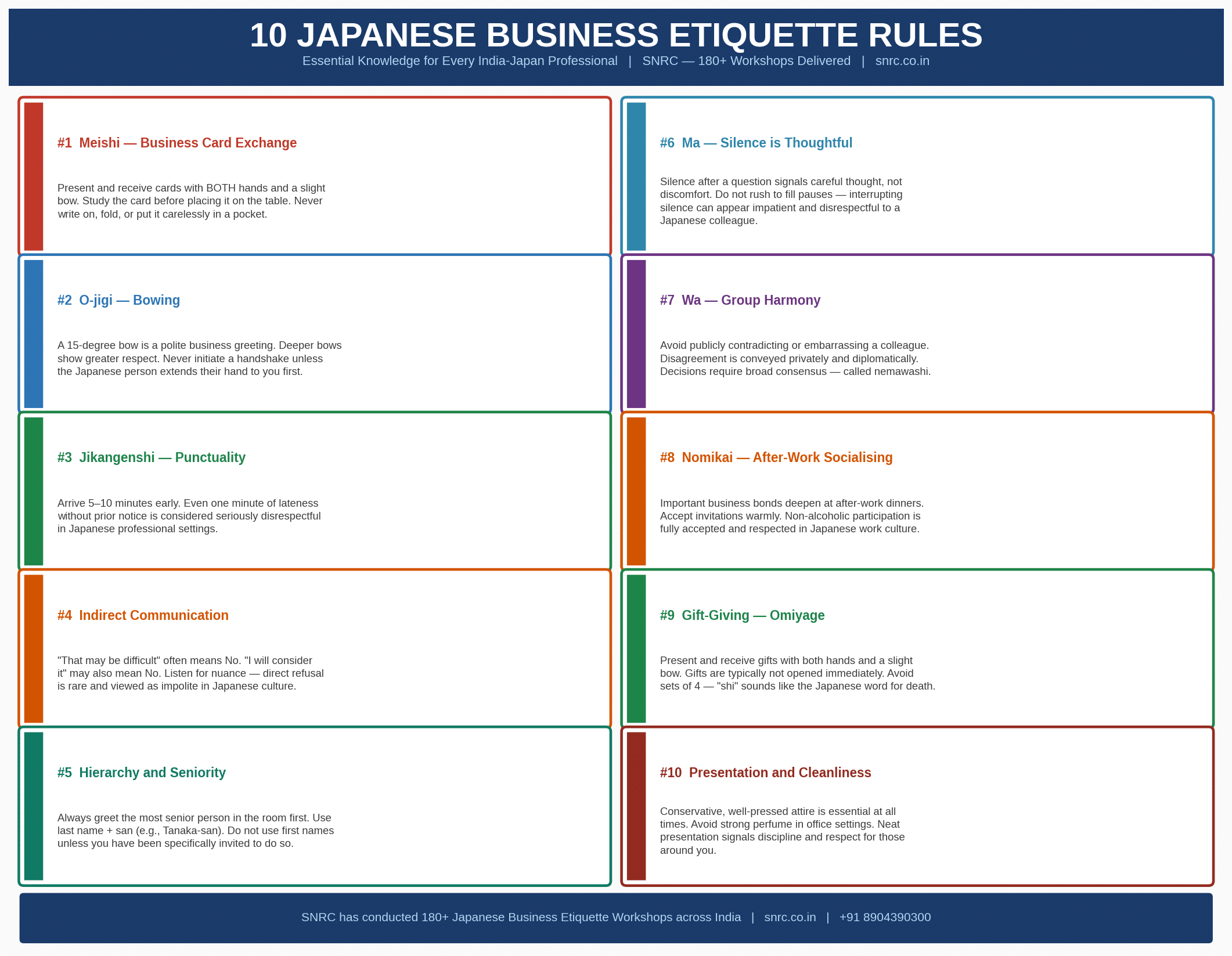
10 Essential Japanese Business Etiquette Rules for Indian Professionals
1. Meishi Koukan — The Business Card Ritual
In Japan, a business card is not just contact information. It represents the person handing it to you.
- Present your card with both hands, face turned toward the recipient, with a slight bow.
- Receive the other person’s card with both hands and take a moment to read it.
- During meetings, place the received card carefully in front of you.
- Never fold, write on, or slip a card into your back pocket.
A small ritual, but the professional respect it signals is enormous.
2. O-jigi — The Language of the Bow
Bowing is Japan’s handshake — layered with meaning.
- A 15° bow (eshaku) is a polite greeting among equals.
- A 30° bow (keirei) shows respect toward seniors and clients.
- A 45° or deeper bow signals apology or reverence.
Don’t initiate handshakes unless your Japanese counterpart offers first. Some are comfortable with both — let them lead.
3. Jikangenshi — Punctuality Isn’t Optional
Punctuality in Japan is treated as a professional obligation, not a courtesy. Even a one-minute delay is noticed.
- Arrive 5–10 minutes early, always.
- If delayed, call ahead, apologise clearly, and share your new arrival time.
- Log in before your Japanese counterpart for virtual meetings.
Indian professionals often underestimate how strongly Japanese teams read punctuality as a signal of reliability.
4. Indirect Communication — Read Between the Lines
Japanese communication is high-context — much is implied.
Watch for phrases like:
- “That may be difficult.” → Usually No.
- “I will consider this.” → Also usually No.
- “It is a bit…” followed by silence → There’s a real problem.
A polite-sounding response without a firm commitment is not a yes. Confirm everything in writing.
5. Hierarchy and Seniority — Respect the Structure
Japanese organisations run on a clear seniority ladder. Recognising it is a sign of professional maturity.
- Greet the most senior person first.
- Address people using last name + san (e.g. Yamamoto-san).
- Wait to be invited before using first names.
Never bypass senior team members to speak directly with juniors.
6. Ma — The Power of Silence
Japan values ma — the meaningful pause. Silence isn’t awkward; it’s thoughtful.
- After a question, wait. Don’t rephrase quickly.
- Avoid filling silences with unnecessary talk.
- A pause before speaking is seen as calm, prepared, and respectful.
Indian professionals often over-explain. Japanese counterparts often listen quietly. This gap alone shapes many meetings.
7. Wa — Group Harmony First
Wa (harmony) is one of the most defining values in Japanese corporate life.
- Never publicly contradict a Japanese colleague.
- Handle disagreements privately, softly, and in writing where possible.
- Big decisions often go through nemawashi — informal consensus-building before formal meetings.
If you understand nemawashi, you understand Japan.
8. Nomikai — Where Real Relationships Are Built
Some of the most important Japanese business conversations happen outside the office — at dinners and drinks called nomikai.
- Accept invitations warmly. Alcohol is optional; participation is not.
- Let the senior-most person initiate the meal.
- Listen carefully — this is where honest opinions are quietly shared.
Declining these gatherings repeatedly can weaken important relationships without you realising it.
9. Omiyage — The Art of Thoughtful Gifting
Gift-giving is a cultural anchor in Japan, especially when travelling.
- Carry regional specialties (omiyage) when visiting a Japanese office.
- Present gifts with both hands and a slight bow.
- Gifts are usually not opened immediately in front of the giver.
- Avoid gifts in sets of 4 (shi = death) or 9 (ku = suffering).
Thoughtfulness matters far more than value.
10. Seiketsukan — Presentation Speaks Loudly
In Japan, presentation reflects discipline.
- Wear conservative, well-pressed attire in first meetings.
- Avoid strong perfumes or colognes.
- Keep workspaces (and video call backgrounds) clean and uncluttered.
The Japanese notice small details — and they interpret them.
Why This Matters for Indian Professionals in 2026
India–Japan business is expanding rapidly — from IT and automotive to healthcare, pharma, and manufacturing. Japanese firms consistently reward professionals who combine language with cultural fluency. Learning Japanese without learning Japanese etiquette leaves a real gap in career impact.
At SNRC, our Japanese Business Etiquette Workshops are designed specifically for Indian corporate teams — customised for IT, automotive, pharma, and government audiences. Over the years, these workshops have helped hundreds of professionals build stronger, more respectful India–Japan working relationships.
📩 Corporate training enquiries: info@snrc.co.in
📞 Call: +91 8904390300
🌐 snrc.co.in — India’s longest‑running 100% Japanese language institute — since 2000.
Frequently Asked Questions: Japanese Business Etiquette
Japanese business etiquette refers to the cultural rules, rituals, and behaviours followed in professional settings in Japan. It includes practices such as business card exchange (meishi koukan), bowing (o-jigi), punctuality (jikangenshi), and indirect communication. Understanding these is essential for building strong India–Japan business relationships.
Indian professionals working with Japanese companies, clients, or teams often face cultural mismatches — especially in communication style, hierarchy, and pace. Mastering Japanese business etiquette helps build trust, avoid misunderstandings, and strengthen career opportunities in Japan-facing roles across IT, automotive, pharma, and manufacturing.
In Japan, business cards are exchanged with both hands, with the card facing the recipient, accompanied by a slight bow. The recipient should read the card briefly before placing it on the table. Never fold, write on, or place the card in a back pocket, as this is considered disrespectful.
In Japanese business culture, phrases like “that may be difficult” or “I will consider this” are often polite ways of saying <strong>no</strong>. Because Japanese communication is high-context, professionals must learn to read implied meaning and confirm all agreements in writing.
Nomikai refers to informal after-work gatherings — usually dinners or drinks — where Japanese colleagues build relationships and share honest opinions. Participation (alcohol optional) shows commitment to the relationship and is often where important business signals are exchanged.
Author – Krishna

