
Embarking on your Japanese language learning journey is an exciting step, full of rich cultural discoveries and incredible professional opportunities. However, as you advance from basic vocabulary to structured communication, a crucial question invariably arises: How do you formally demonstrate your proficiency to global employers, academic institutions, and immigration authorities?
Understanding the JLPT: The Traditional Gold Standard and NAT
In the landscape of Japanese language education, two primary standardized examinations carry international prestige and institutional acceptance: the long-established JLPT (Japanese Language Proficiency Test) and the highly flexible NAT-TEST (Nihongo Achievement Test). While both exams accurately evaluate your linguistic mechanics—reading, listening, grammar, and vocabulary—they serve slightly different tactical purposes and suit different learning timelines.
This comprehensive guide breaks down the core distinctions between the JLPT and NAT-TEST so you can make an informed, strategic decision for your career. Or, like many ambitious students at Sakuraa Nihongo Resource Centre (SNRC), you might discover that leveraging both certifications simultaneously is the fastest path to professional success.
Understanding the JLPT: The Traditional Gold Standard
The Japanese Language Proficiency Test (JLPT) is universally recognized as the world’s premier, authoritative Japanese language certification. Jointly administered by the Japan Foundation and Japan Educational Exchanges and Services (JEES), the JLPT is offered across more than 80 countries worldwide. In India, the exam is conducted exactly twice a year—on the first Sunday of July and December—spanning eight major hubs including Bangalore, Delhi, Mumbai, Chennai, Pune, Kolkata, Santiniketan, and Karur.
The JLPT architecture is divided into five progressive tiers, from N5 (foundational beginner) to N1 (advanced business mastery). Because of its direct institutional backing by the Japanese government, the JLPT remains the undisputed ‘gold standard’ for major multinational corporations in India, academic admissions at elite universities in Japan, and official highly-skilled visa point calculations.
Understanding the NAT-TEST: The Modern, High-Flexibility Alternative
The Nihongo Achievement Test (NAT-TEST) is a highly respected, rigorous alternative proficiency exam administered by the Japanese Language Proficiency Test Administration (JLPTA), a prominent non-profit organization based in Japan. The NAT-TEST framework is consciously designed to mirror the JLPT step-for-step, utilizing five matching levels that run from 5Q (equivalent to N5) up to 1Q (equivalent to N1).
The defining advantage of the NAT-TEST is its exceptional calendar frequency. It is administered six times a year—occurring bi-monthly in January, March, May, July, September, and November. This frequent testing rotation provides candidates with an unprecedented speed-to-certification advantage, removing the stressful six-month waiting periods inherent to the JLPT.
Head-to-Head Comparison: At a Glance
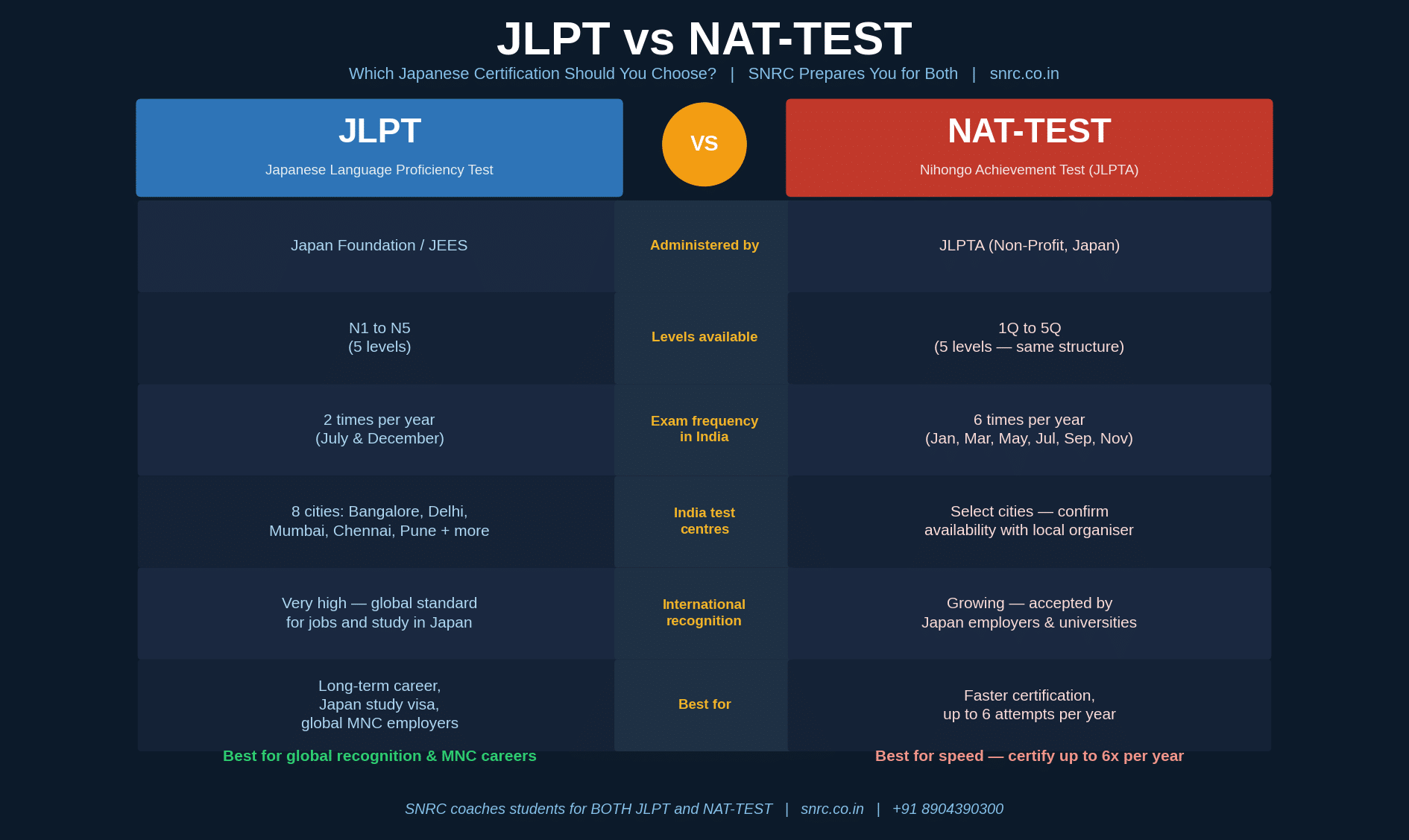
To help visualize how these two certifications stack up against each other structurally and logistically, review the comparative matrix below:
Evaluation Factor | JLPT (Japanese Language Proficiency Test) | NAT-TEST (Nihongo Achievement Test) |
Administering Authority | Japan Foundation / JEES (Government-backed) | JLPTA (NPO Japan) |
Proficiency Levels | N1 (Highest) to N5 (Lowest) — 5 Levels | 1Q (Highest) to 5Q (Lowest) — Mirroring JLPT |
Exam Frequency (India) | 2 times per year (Fixed: July & December) | 6 times per year (Bi-monthly: Jan, Mar, May, Jul, Sep, Nov) |
Testing Centres (India) | 8 Primary Hubs: Bangalore, Delhi, Mumbai, Chennai, Pune, Kolkata, Santiniketan, Karur | Select designated metro cities (Availability confirmed per round) |
Global Recognition | Universal / Absolute authority for corporate recruitment, university degrees, and visa points | Substantial & Growing; widely accepted by Japanese employers and language schools |
Speed to Certification | Slower — Maximum of 2 attempts per year with extended evaluation turnarounds | Accelerated — Up to 6 attempts per year; fastest path to secure official credentials |
Ideal Candidate Path | Long-term corporate positioning, formal overseas university tracks, global MNC hiring | Rapid career progression, visa filing readiness, interim progress checks |
Fee Structure (India) | ₹2,000 to ₹3,500 (Varies based on targeted level and center) | Comparable localized range (Coordinated via local regional testing organizers) |
Fascinated by Japan? Learn the language at SNRC — JLPT N5–N1 & NAT 5Q–1Q. Free demo: +91 8904390300.
Strategic Recommendations: Navigating Your Best Pathway
Choosing the perfect certification strategy depends completely on your unique personal context, professional milestones, and immediate operational timelines. At SNRC, we closely analyze each student’s career vision to provide highly specialized advice:
Targeting Leading Japanese MNCs in India? Choose JLPT. If your core professional ambition is to secure a lucrative role within a Japanese multinational corporation operating in India—such as Toyota, Bosch, Hitachi, Toshiba, or TCS—the JLPT carries an unmatched, deeply-entrenched brand recognition among corporate HR panels. It acts as an instant differentiator on your executive resume.
Urgent Timelines or Rapid Milestones? Leverage NAT-TEST. If you need to produce an official language proficiency certificate rapidly to meet strict visa processing deadlines, language school intakes, or corporate promotion cycles, do not wait six months for the next JLPT cycle. The NAT-TEST allows you to test, review, and certify at an accelerated bi-monthly pace.
Relocating directly to Japan for Career or Education? Rely on JLPT. For direct admissions into prestigious Japanese universities and strong professional immigration work-visa support, the JLPT is heavily favored. Aiming for an N2 or N1 certification level is highly recommended to thrive in competitive native environments.
Corporate Training and On-Site Deployments? Pursue Both Co-Currently. For corporate working professionals undergoing structured upskilling for immediate or mid-term on-site project relocation to Japan, attempting both examinations simultaneously is highly effective. Because the core syllabi are identical, taking the NAT-TEST acts as a high-stakes, realistic dress rehearsal that secures an early credential while removing the psychological pressure from your final JLPT attempt.
The SNRC Advantage: Complete Dual-Exam Readiness
One of the major bottlenecks students face at single-exam institutes is having their academic progress tethered strictly to a December or July calendar. SNRC completely eliminates this friction. As one of the premier institutes engineered for comprehensive Japanese training in India, our dual-readiness framework covers the entire spectrum of both JLPT (N5–N1) and NAT-TEST (5Q–1Q) curriculums simultaneously.
Because the underlying vocabulary, grammatical structures, kanji depth, and listening matrices are completely aligned, our master curriculum trains you holistically. When you enroll in a course at SNRC, you are not just preparing for a single date on a calendar; you are gaining comprehensive language mastery that qualifies you to clear either or both examinations interchangeably within the exact same academic year.
Take Your Next Step with SNRC
Ready to accelerate your professional Japanese certification and unlock global career opportunities? Experience our proprietary interactive teaching methodology firsthand. Book your complimentary personal demo session today by connecting with our senior academic counselors at +91 8904390300 or explore our full suite of customized corporate and individual language solutions at snrc.co.in.
Author – Krishna