
INTRO – If you are thinking of learning Japanese, one of the first questions you will have is: How long will it take?
The honest answer is it depends on your goals. For most learners:
• Basic level (N5): 3–4 months
• Intermediate (N3): 12–15 months
• Professional level (N2): 18–24 months
At SNRC, based on over 25 years of training students, we have seen consistent, realistic timelines that match international benchmarks like those from the Japan Foundation and the Foreign Service Institute.
If you attend regular classes and study consistently, here is what you can expect.
What Is a Realistic Timeline to Learn Japanese?
For a beginner starting from zero, a structured learning approach gives predictable results.
Most SNRC students follow a schedule of:
• 3 classes per week
• 1 hour of self-study daily
With that consistency, learning Japanese becomes a step-by-step process.
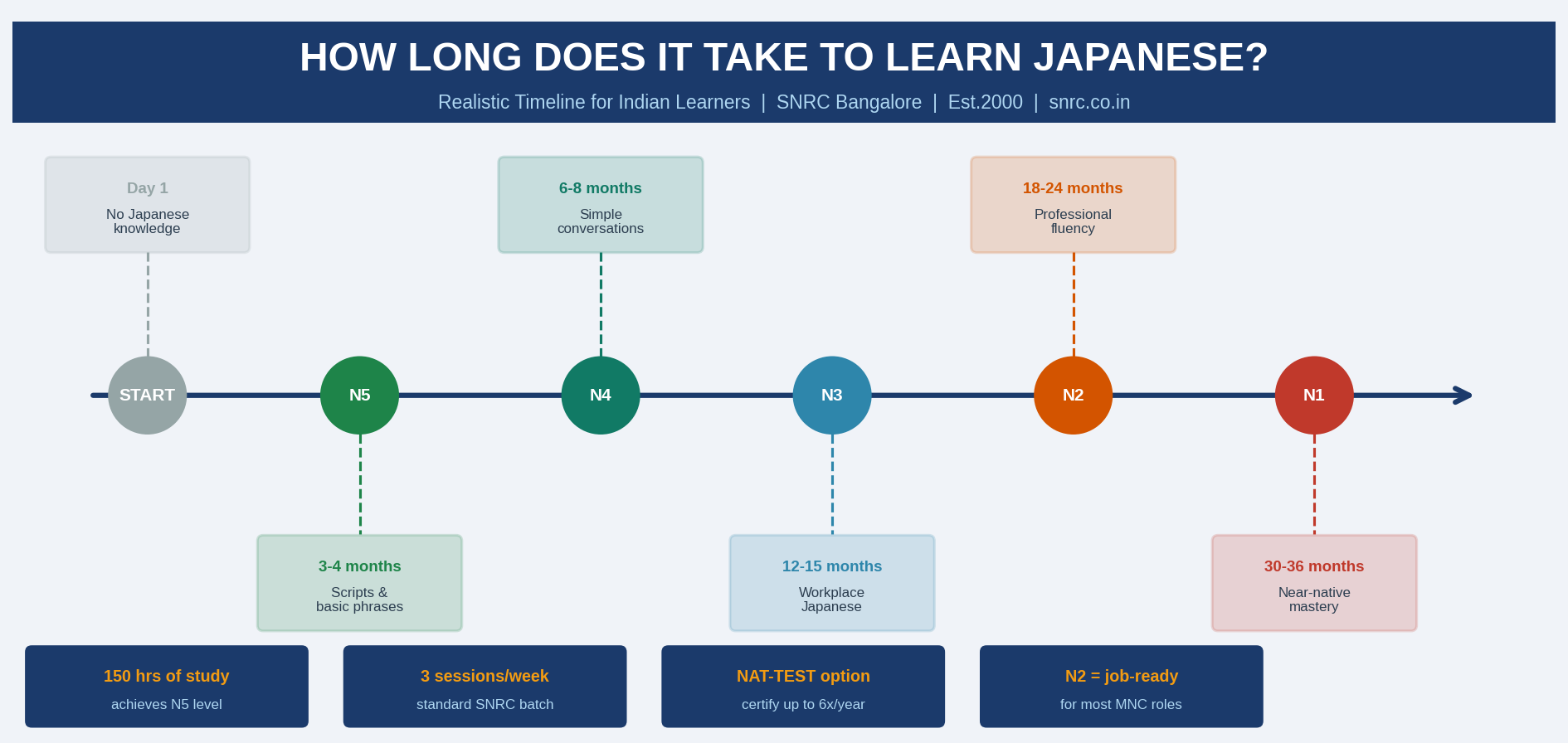
Japanese Learning Timeline (JLPT Levels Explained)
Level | Time from Zero | Study Hours | Weekly Commitment | You Can Do |
3–4 months | ~150 hrs | 3 classes + 1 hr/day | Read hiragana/katakana, hold basic conversations, introduce yourself | |
6–8 months | ~300 hrs | 3 classes + 1 hr/day | Discuss daily topics, read simple texts, handle basic workplace phrases | |
12–15 months | ~400 hrs | 3 classes + 1.5 hr/day | Handle workplace Japanese, read newspapers partially, basic business email | |
N2 | 18–24 months | ~600 hrs | 3 classes + 2 hr/day | Full professional communication, business meetings, complex document translation |
30–36 months | 900+ hrs | Daily intensive study | Near-native fluency, interpretation, senior corporate roles, Japan relocation |
What Affects How Fast You Learn Japanese?
1. Consistency Matters More Than Talent.
Students who attend regularly and practise daily progress much faste
2. Your Language Background Helps
If you know Indian languages with complex scripts, Japanese writing becomes easier to pick up.
3. Clear Goals Speed Up Progress
Students preparing for exams (JLPT/NAT) or job interviews move faster because they have deadlines.
4. NAT-Test Advantage
Since NAT happens multiple times a year, it helps track progress and stay motivated.
5. Practice Outside Class
Watching anime, listening to Japanese audio, and video can accelerate learning.
Common Myths About Learning Japanese
| Myth | Reality |
“Japanese is the hardest language in the world” | Japanese grammar is actually quite logical — verb conjugation is more regular than English and there are no gendered nouns. Scripts take 3–4 months to master. The challenge is kanji, which requires consistent practice. |
“You need to be good at languages” | SNRC has successfully trained engineers, doctors, accountants, and housewives with no prior language-learning background. Motivation matters more than natural ability. |
“N2 takes at least 3 years” | Students who study 3 sessions per week plus daily self-study consistently achieve N2 in 18–24 months. Several SNRC students have achieved N2 in 20 months from zero. |
“Online Japanese learning is less effective” | Apps and self-study cannot replicate structured exam preparation, personalised error correction, and the accountability of a classroom. SNRC’s OJaS live online classes combine the best of both worlds with live instructors. |
Frequently Asked Questions
Here are some common questions learners ask before starting Japanese:
Learning Japanese from zero typically takes 3 to 4 months to reach JLPT N5, the beginner level, with regular study. Reaching professional proficiency (JLPT N2) usually takes 18 to 24 months, depending on consistency, study time, and learning method. Structured classroom training combined with daily practice significantly speeds up progress.
Yes, it is possible to learn basic Japanese in 6 months and reach around the JLPT N4 level, provided you study consistently. Most learners can hold everyday conversations, read simple text, and understand basic grammar within this time. However, higher levels like N2 or N1 require longer-term structured learning.
Most jobs requiring Japanese language skills expect a minimum of JLPT N3 or N2, depending on the role. N3 is sufficient for entry-level positions, while N2 is typically required for professional roles involving communication, documentation, or client interaction. Higher-level roles may prefer N1.
Japanese is considered more challenging than English for beginners because of its writing systems and kanji. However, Japanese grammar is logical and consistent, making it easier to learn with practice. With structured learning and regular study, most learners can progress steadily regardless of prior language experience.
There are several institutes where you can learn Japanese in Bangalore, but choosing a structured program is important. A good course should cover JLPT levels, provide regular practice, and offer guidance from experienced trainers. . Not sure where to start? Read: How to choose the best institute
Yes, SNRC offers online Japanese classes. Online learning is especially useful for working professionals who cannot travel regularly. With structured teaching, live interaction, and proper practice, online Japanese classes can be as effective as classroom training.
Whether you are in Whitefield, Indiranagar , Electronic City, Pune , Hyderabad or Singapore you can start learning with flexible options.
Author – Krishna

